
被切开的颅骨、核磁共振和150多年的疑问:“恶”是否有生物学基础
2026-09-28 19:27:34
1876年,意大利都灵的一间解剖室里,监狱医生龙勃罗梭(Cesare Lombroso)正在解剖一具尸体——死者是当地强盗头目维莱拉。刀切开颅骨时,他在枕骨看到一个凹陷,那是低等灵长类才有的结构。多年后他回忆那一刻,说自己“仿佛看见一道闪电划开黑暗”;那是晚年的追忆,几分修辞,已无从分辨。
龙勃罗梭1909年去世,他的理论如今是教科书里的失败案例。但他提的问题没有跟着下葬——一百多年后,卡尺换成了基因测序与脑成像,问题还是同一个:恶,是不是天生的?
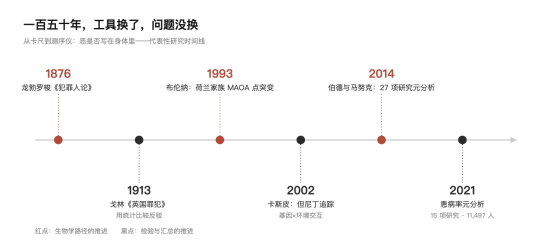
图1.一百五十年,六项代表性研究:工具换了,问题没换
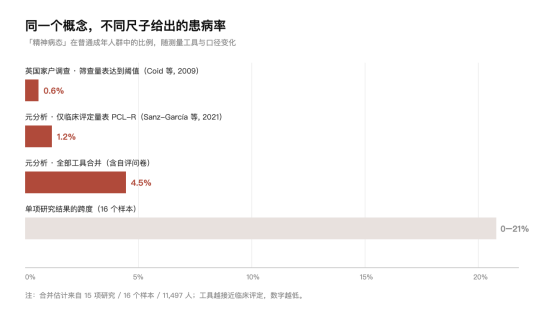
图2.同一概念,不同测量工具给出的患病率。数据来源:Coid et al. 2009;Sanz-García et al. 2021
2002年,研究者在新西兰但尼丁追踪了一千多名居民二十多年,谁在童年遭过虐待、谁没有,都有记录。他们检验的是低活性MAOA变体与反社会行为的关系。如果恶由基因单独决定,携带者该普遍更危险。结果分成两支:
携带低活性变体、童年遭受过虐待的:成年后反社会行为显著增多
携带同一变体、童年未被虐待的:反社会行为没有增加
还有一层常被漏掉:基因与环境并非随机配对。天生冲动、难带的孩子,更容易耗尽父母的耐心,也更容易被老师归入问题学生、被同伴疏远——这个循环里没有人存心作恶。恶常常是这样长起来的:一场滑坡,每一步都有各自的理由。
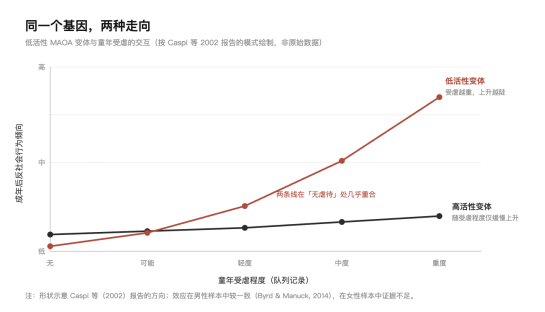
图3.基因×环境交互示意(按Caspi et al. 2002报告的模式绘制,非原始数据)
1. Lombroso C. (1876). L'uomo delinquente.(《犯罪人论》)
2.Goring C. (1913). The English Convict: a Statistical Study. H.M.S.O.
3.Cohen L.E. & Felson M. (1979). Social change and crime rate trends: a routine activity approach. American Sociological Review, 44(4), 588-608.
4.Lerner M.J. (1980). The Belief in a Just World. Plenum Press.
5.Brunner H.G. et al. (1993). Abnormal behavior associated with a point mutation in the structural gene for monoamine oxidase A. Science, 262(5133), 578-580.
6.Baumeister R.F. (1997). Evil: Inside Human Violence and Cruelty. W.H. Freeman.
7.Salminen J.K. et al. (1999). Prevalence of alexithymia and its association with sociodemographic variables in the general population of Finland. Journal of Psychosomatic Research, 46(1), 75-82.
8.Caspi A. et al. (2002). Role of genotype in the cycle of violence in maltreated children. Science, 297(5582), 851-854.
9.Krug E.G. et al. (2002). World Report on Violence and Health. World Health Organization.
10.Kosfeld M. et al. (2005). Oxytocin increases trust in humans. Nature, 435(7042), 673-676.
11.Blair R.J.R. (2007). The amygdala and ventromedial prefrontal cortex in morality and psychopathy. Trends in Cognitive Sciences, 11(9), 387-392.
12.Coid J. et al. (2009). Psychopathy and psychopathic traits in the household population of Great Britain. International Journal of Law and Psychiatry, 32(2), 65-73.
13.Byrd A.L. & Manuck S.B. (2014). MAOA, childhood maltreatment, and antisocial behavior: meta-analysis of a gene-environment interaction. Biological Psychiatry, 75(1), 9-17.
14.Abramson L. et al. (2020). The genetic and environmental origins of emotional and cognitive empathy: Review and meta-analyses of twin studies. Neuroscience & Biobehavioral Reviews, 114, 113-133.
15.Declerck C.H. et al. (2020). A registered replication study on oxytocin and trust. Nature Human Behaviour, 4(6), 646-655.
16.Sellbom M. & Drislane L.E. (2021). The nature of psychopathy: an introduction to the special issue. Personality Disorders, 12(1), 1-4.
说明:精神病态患病率、遗传度等数字均随测量工具与人群变化,本文按原始文献口径给出;“类别 vs 维度”之争仍在进行,正文保留余地。文章由 AI 辅助创作,仅供参考。

 CHTV 百姓健康微信